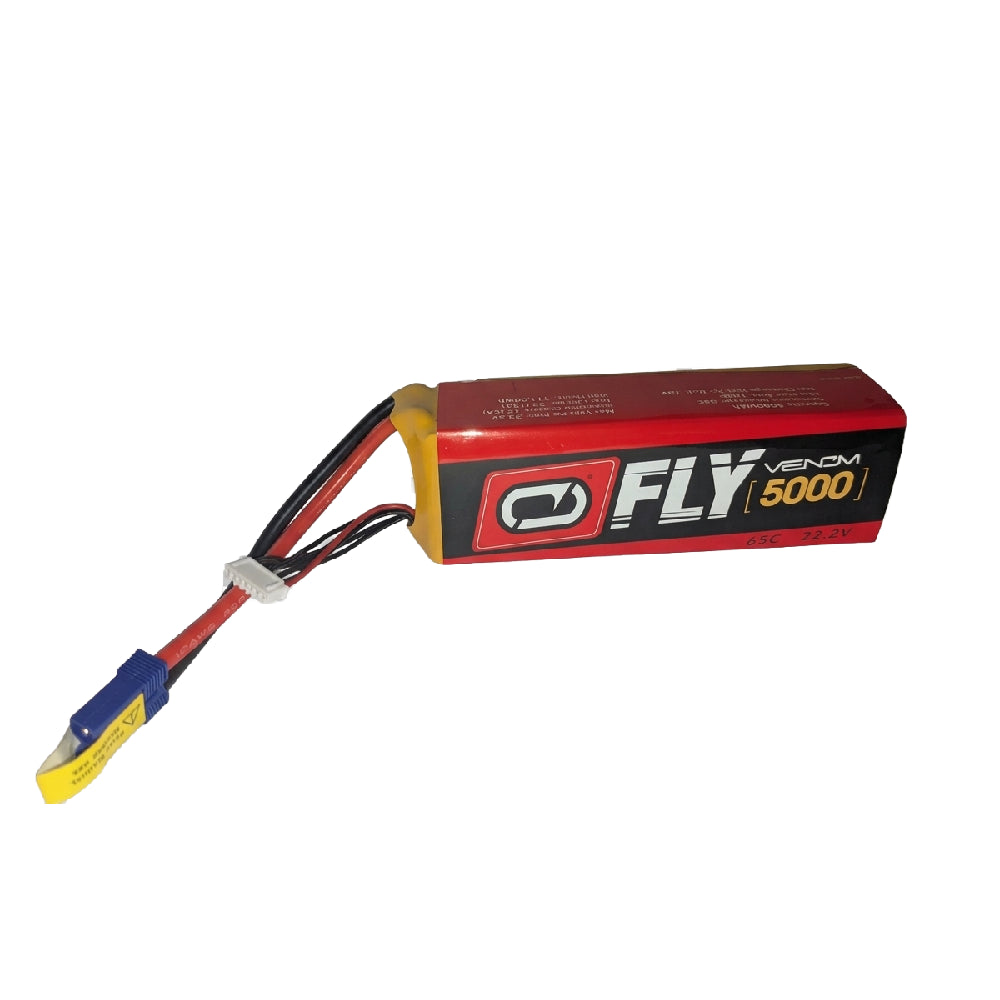
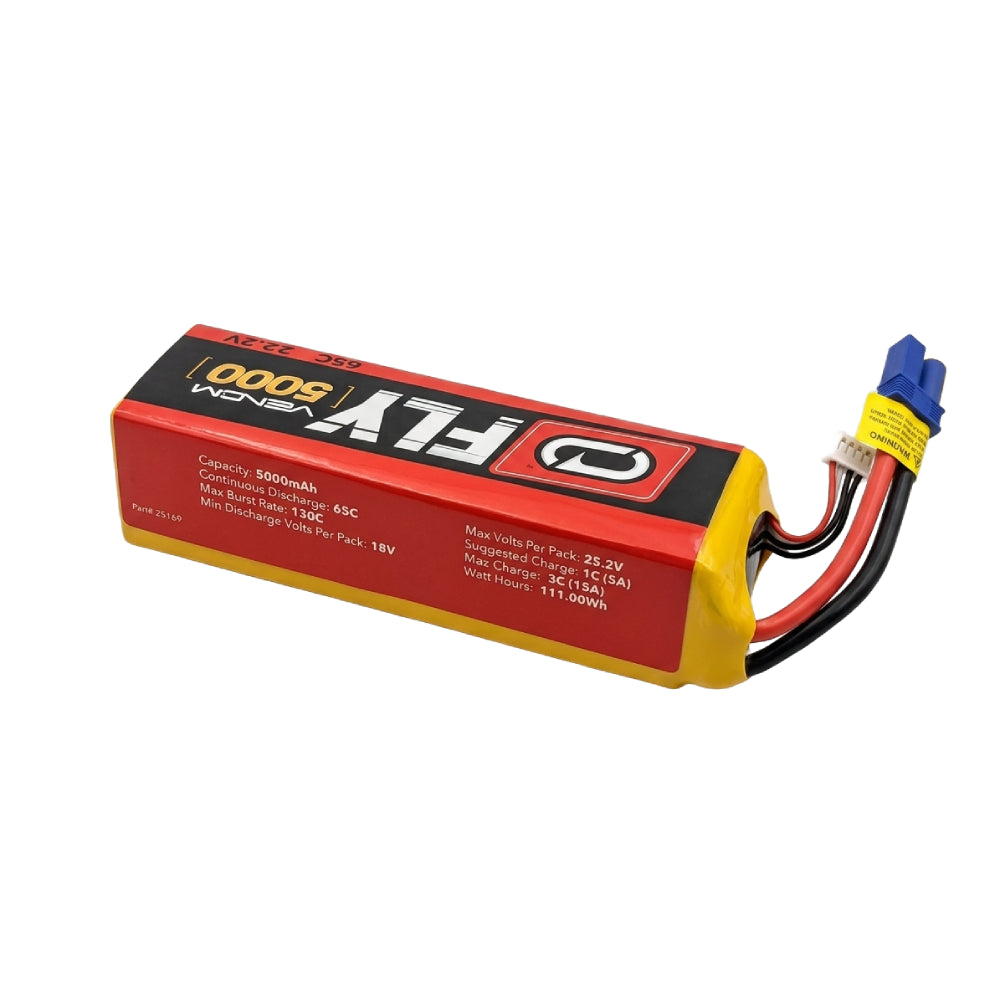
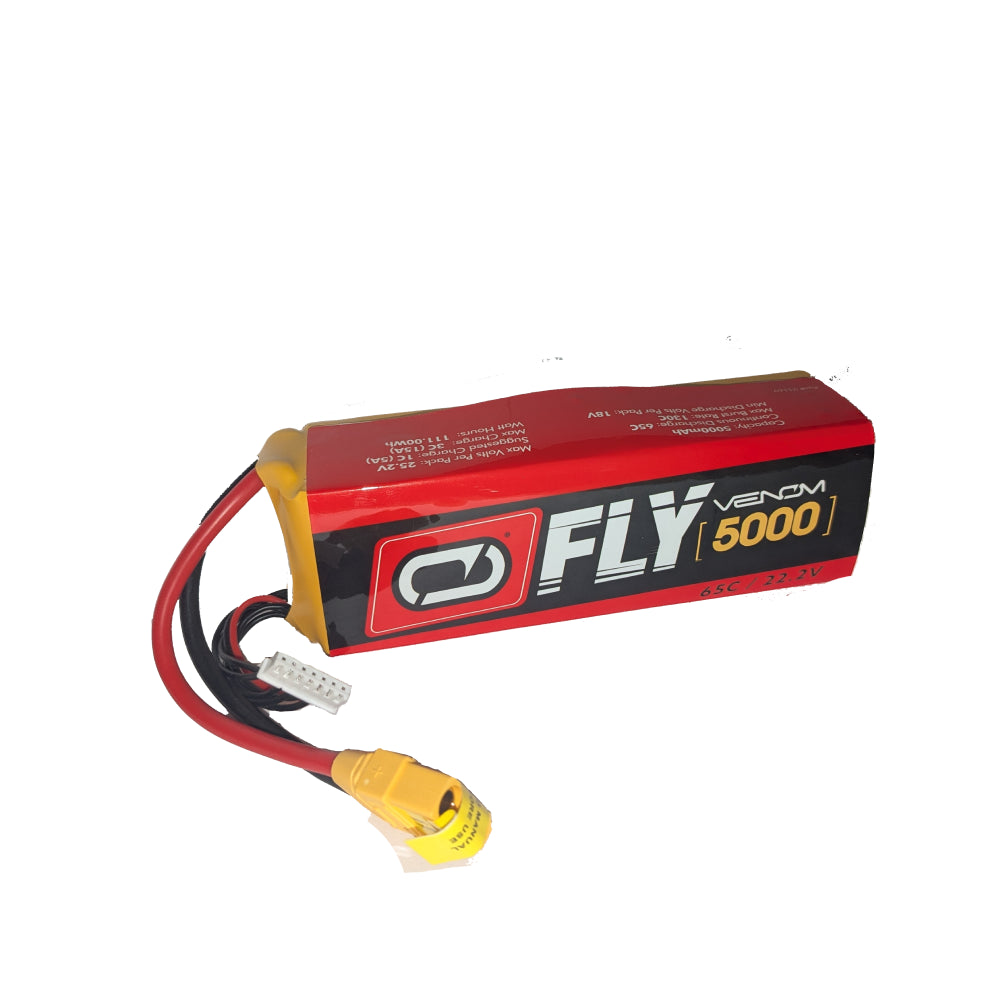
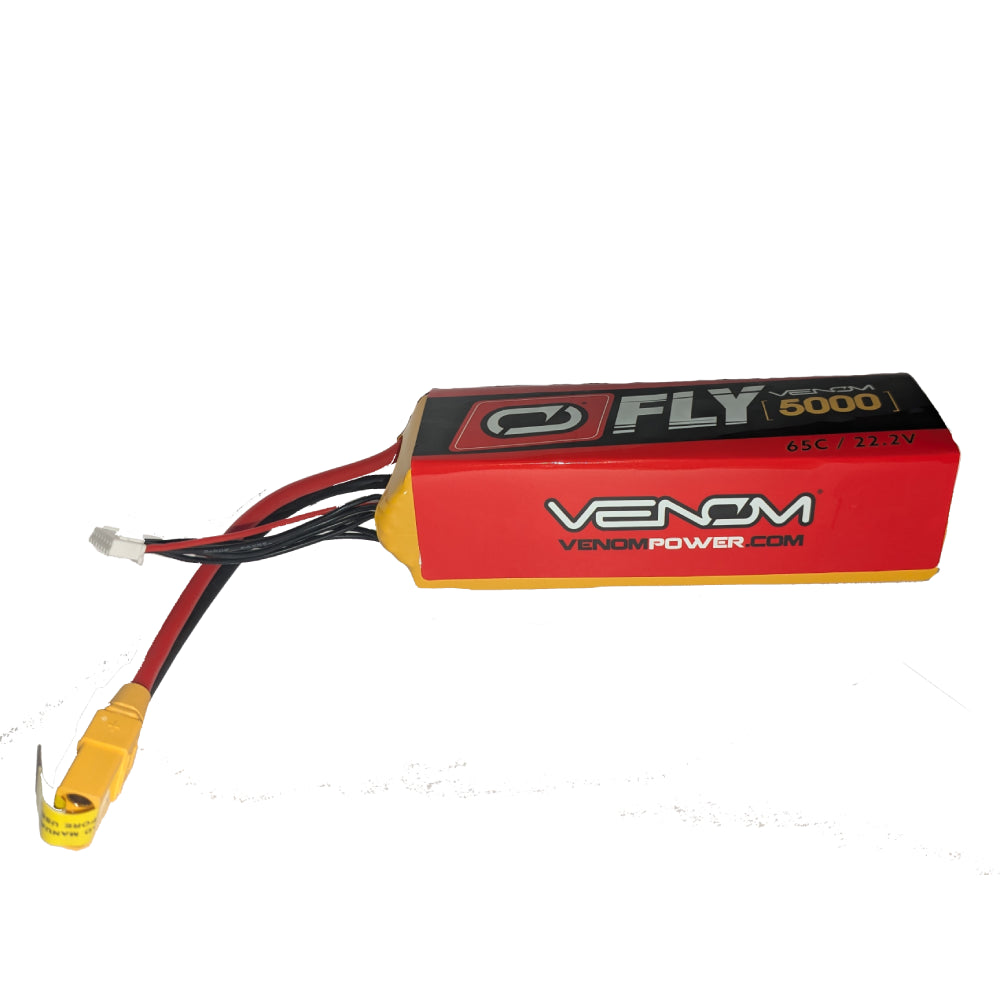
Venom Power 5000 mAh 22.2V 6S 65C LiPo Battery
Venom Power 5000 mAh 22.2V 6S 65C LiPo Battery
Couldn't load pickup availability
Product Info & Specs
Product Info & Specs
Overview
Key Specifications
| Feature | Specification |
| Battery Type | Lithium Polymer (LiPo) |
| Configuration | 6S1P (6 Cells in Series) |
| Nominal Voltage | 22.2V (25.2V Max / 4.2V per cell) |
| Capacity | 5000 mAh / 111.0 Wh |
| Continuous Discharge Rate | 65C (325.0 A max) |
| Peak Burst Discharge Rate | 130C (650.0 A max) |
| Max Charge Rate | 5C (25.0 A max) |
| Recommended Charge Rate | 1C (5.0 A) |
| Balance Connector | JST-XH |
| Dimensions (L x W x H) | 154 mm × 48 mm × 43 mm |
| Weight | ~695 g |
Product Features & Highlights
-
High-Amp Power Delivery: Capable of sustaining up to 325A continuous discharge (7,215W) and 650A peak burst (14,430W) for high-load throttle punches and vertical maneuvers.
-
Large Capacity Footprint: 5000mAh capacity provides high energy density (111 Wh) for extended runtimes without sacrificing punch.
-
Rapid 5C Charging: Supports charging up to 25A on compatible LiPo balance chargers, allowing full recharges in approximately 12 minutes.
-
Standard Balance Lead: Fitted with a universal JST-XH balance connector for seamless compatibility with most individual-cell balance chargers.
Frequently Asked Questions
How much continuous power can this 6S 5000mAh 65C LiPo produce?
What is the maximum charging current for a 5000mAh 5C battery?
What balance plug is used on this 6S battery pack?
Battery Safety Information
Battery Safety Information
LiPo Battery Safety, Handling & Disposal Guidelines
Lithium Polymer (LiPo) batteries pack high energy density into lightweight designs, making them ideal for RC vehicles, drones, and high-performance electronics. However, improper charging, storage, or physical damage can result in fire, property damage, or severe personal injury. By purchasing and using our products, you acknowledge these risks and agree to follow all safety protocols below:
1. Pre-Use & Physical Inspection
-
Inspect Before Every Use: Never use, charge, or store a battery that is swollen ("puffed"), punctured, dented, leaking, or has damaged wires/connectors.
-
Age & Experience Requirement: High-discharge LiPo packs (especially 4S–6S and above) are intended for adults or experienced hobbyists under direct adult supervision.
-
Never Modify Packs: Do not disassemble, puncture, crush, or attempt to rewire internal battery cells.
2. Safe Charging Rules
-
Use a LiPo-Compatible Balance Charger Only: Never charge a LiPo battery using a NiMH, NiCd, or standard DC power supply. Always use a dedicated microprocessor-controlled LiPo balance charger.
-
Always Balance Charge: Connect both the main discharge lead and the JST-XH balance plug during every charge cycle so individual cell voltages remain equalized.
-
Never Charge Unattended: Remain present and alert throughout the entire charging process. If a pack begins to swell, smoke, or feel warm to the touch, disconnect power immediately from a safe distance.
-
Use a Fireproof Charging Enclosure: Always place batteries inside a certified LiPo Safe Fireproof Bag, ceramic container, or vented steel ammo box on a non-flammable surface (such as concrete or tile) away from curtains, wood, and carpets.
-
Follow the 1C Charge Rate Rule: Unless explicitly rated higher on the battery label, charge at 1C or lower (e.g., charge a 5,000mAh pack at a maximum of 5.0 Amps).
-
Never Overcharge: Individual LiPo cells must never exceed 4.20V per cell (or 4.35V per cell for LiHV packs).
3. Operation & Low-Voltage Protection
-
Set Your Low-Voltage Cutoff (LVC): Configure your Electronic Speed Controller (ESC) or flight controller LVC to at least 3.2V–3.4V per cell under load.
-
Never Over-Discharge: Discharging a LiPo cell below 3.0V causes permanent internal damage and increases fire risk during future charging cycles.
-
Allow Cool-Down Time: After running a battery, allow it to cool completely to ambient room temperature before recharging or placing it into storage.
4. Storage & Transportation Guidelines
-
Use Storage Voltage (3.80V–3.85V per Cell): Never store LiPo batteries fully charged (4.20V/cell) or fully depleted for more than 48 hours. Use your balance charger’s "Storage" mode to bring cells to 3.80V–3.85V per cell before putting them away.
-
Temperature Control: Store batteries in a cool, dry location between 50°F and 70°F (10°C – 21°C). Never leave batteries inside a parked vehicle, in direct sunlight, or near heat sources.
-
Protect Connectors from Short Circuits: Ensure battery terminals never touch metal tools, keys, coins, or other battery leads. Use terminal caps when storing or transporting packs.
5. Emergency & Fire Response
-
Do Not Use Water on Active Lithium Fires: If a LiPo battery catches fire, evacuate the area immediately and call emergency services.
-
Fire Suppression: Smother small battery fires using Class D fire extinguishers, dry sand, or baking soda. Ventilate the area thoroughly once the fire is out, as LiPo smoke contains toxic fumes.
6. Safe Disposal & Recycling
-
Never Throw in Household Trash: Damaged, puffed, or end-of-life LiPo batteries must never be placed in standard garbage or curbside recycling bins.
-
Discharge to 0V Before Recycling:
-
If safe to do so (and the pack is not actively smoking or leaking), slowly discharge the battery down to 0.0V using a dedicated battery discharger, a low-wattage 12V incandescent bulb, or a salt-water bath (1/2 cup of salt per gallon of water, submerged outdoors in a plastic bucket for 24–48 hours).
-
Verify with a multimeter that the voltage reads 0.0V.
-
Tape over the exposed connector leads with electrical tape.
-
-
Drop Off at a Certified Facility: Take the fully discharged pack to a local municipal hazardous waste facility or a certified battery drop-off location (such as Call2Recycle).
7. HAZMAT Shipping & Returns Notice
-
UN3480 / UN3481 Compliance: Loose lithium polymer batteries are classified as Regulated Dangerous Goods and ship via certified Ground Transportation only with required exterior hazard labeling.
-
Return Restrictions: Due to federal transport laws governing damaged or loose lithium batteries, do not ship any battery back to us without prior Return Authorization (RMA) and approved packaging instructions.
Share